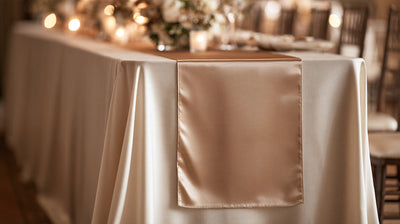
For a traditional look, add 12 to 24 inches to your table's length. On a 6-foot table, an 84-inch runner hangs 6 inches over each end, while a 96-inch runner gives you a 12-inch drop. If you prefer no overhang, a shorter runner that stays on the tabletop works too.
The right length depends partly on how you're setting the table. For a wedding or formal dinner, you might want the fabric to hang down a little. For everyday dining, a shorter runner may be more convenient, especially if people are sitting at both ends. Here's how common table runner sizes compare with different table lengths.
Table Runner Size Chart: Find the Right Length
Measure the tabletop from end to end before buying table runners. Don't include the chairs or estimate the length based on how many people the table seats.
The table runner size chart below shows what to look for if you want 6 to 12 inches of fabric hanging over each end.
| Table Length | Suggested Runner Length | Overhang Per End |
|---|---|---|
| 36 inches (3 ft) | 48–60 inches | 6–12 inches |
| 48 inches (4 ft) | 60–72 inches | 6–12 inches |
| 60 inches (5 ft) | 72–84 inches | 6–12 inches |
| 72 inches (6 ft) | 84–96 inches | 6–12 inches |
| 84 inches (7 ft) | 96–108 inches | 6–12 inches |
| 96 inches (8 ft) | 108–120 inches | 6–12 inches |
| 108 inches (9 ft) | 120–132 inches | 6–12 inches |

These lengths aren't mandatory. If you have chairs at the ends of the table, you may prefer less overhang so the fabric doesn't get caught when someone sits down. For a decorative table without end seating, a longer drop may look better.
Check the product measurements rather than relying on labels such as “fits a 6-foot table.” That description doesn't tell you how much fabric will actually hang over the edges.
How Much Should a Table Runner Hang Over?
For most dining tables, 6 to 12 inches of overhang on each end looks about right. You can go shorter or longer, depending on the table and how you plan to use it.
Six inches is usually enough for an everyday dining table. The runner hangs just below the edge, without leaving too much fabric near the chairs.
For a wedding reception or Christmas dinner, you might prefer 8 to 12 inches. That gives the fabric a longer drop, particularly if you're using something soft like satin or chiffon. Just check how it hangs once you've set the table.
If you're asking how much should a table runner hang over, look at the seating first. Someone sitting at the head of the table shouldn't have to move the runner out of the way every time they pull in their chair.
You can skip the overhang altogether, too. A runner that ends a few inches before the table's edges works for everyday meals, coffee tables, or a dining table where you mainly want something underneath the centerpiece.
How to Measure for a Table Runner
Grab a measuring tape and check your table's length. Once you have that number, the rest is simple.

Step 1: Measure Your Table
For a rectangular table, measure straight from one end of the tabletop to the other.
If you have a round table, measure across the middle to get the diameter.
Have an extendable dining table? Make sure the leaves are in place if you'll be using them for the occasion. Otherwise, you could end up buying a runner that's too short when the table is fully extended.
Write down the measurement in inches.
Step 2: Decide on the Overhang
Now decide how much fabric you want hanging off each end.
For example, you could go with 6 inches for a regular family dinner or 10 inches if you're dressing the table for a special occasion.
Use the same measurement at both ends. Otherwise, the runner will hang lower on one side.
Step 3: Calculate the Length
Here's the formula for working out your table runner length:
Runner length = Table length + (Overhang × 2)
Say your table is 72 inches long, and you've decided on a 9-inch drop at each end.
72 + (9 × 2) = 90 inches
So you'd need a 90-inch runner.
That's an extra 18 inches of fabric altogether, with 9 inches hanging over each end.
Step 4: Check the Width
A runner can be the right length and still be too wide for the table. Once you've added dinner plates, glasses, and serving dishes, there might not be much space left.
For a 36-inch-wide dining table, I'd start with a 12-inch runner. That's roughly one-third of the table's width, leaving 12 inches on either side for place settings.
If you're decorating a buffet or display table, you have more freedom to go wider. You won't have people eating on either side, so there's more room for flowers, candles, and other decorations.
The fabric matters, too. Our guide on how to choose a table runner covers a few things worth checking before you buy.
What Size Table Runner Do I Need for Different Tables?
A runner doesn't sit quite the same way on every table. Rectangular tables are fairly simple, but round tables give you a couple of different ways to arrange the fabric.
Rectangular Dining Tables

On a rectangular dining table, the runner usually goes down the middle, along the table's length.
Take a table that measures 60 inches from end to end. With a 72-inch runner, you'll have 6 inches hanging down at each end. An 84-inch runner gives you a 12-inch drop instead.
Either length works. It's mostly a matter of how much fabric you want hanging over the edges.
Width is worth checking before you order, particularly on a narrow dining table. You don't want the runner taking up the space where the dinner plates are supposed to go.
Round Tables

For a round table, measure straight across the middle. That measurement is the diameter, and it's what you'll use to work out the runner length.
A 48-inch round table, for instance, would have a 6-inch drop on each side with a 60-inch runner. Switch to a 72-inch runner, and the drop becomes 12 inches.
There's another way to arrange runners on a round table. Take two narrow ones and lay them across each other to form a cross. You'll end up with four sections around the table, which can work well if you're setting four places.
It's also an option if you like the look of your tabletop and don't want to cover the whole thing with a tablecloth.
Square Tables

For a square table, measure one side and add 12 to 24 inches if you want the runner to hang over the edges.
On a 42-inch square table, that means a runner between 54 and 66 inches long.
For smaller tables, a shorter runner may make more sense. You can leave a few inches of the tabletop showing at each end, particularly if you need room for plates and glasses.
Oval Tables
Measure an oval table from one end to the other, along its longest point. Then add the amount you want hanging over both ends.
Because the ends are curved, the fabric won't hang quite the same way it does on a rectangular table. Try the runner on the table before arranging your decorations, and move it until the drop looks even.
What Size Table Runner for a 6 Foot Table?
A 6-foot table is 72 inches long. If you want the runner to hang over the ends, 84 to 96 inches is the usual range.
Here's what those lengths look like:
- 84-inch runner: 6 inches hanging over each end
- 90-inch runner: 9 inches hanging over each end
- 96-inch runner: 12 inches hanging over each end
Already have a 72-inch runner? You can use that too. It'll reach the ends of the table without hanging down. A shorter one can sit in the middle, underneath a flower arrangement or centerpiece.
You don't necessarily need to buy a new runner just because yours doesn't hang over the edges.
What Size Table Runner for an 8 Foot Table?
For an 8-foot table, which measures 96 inches long, look for a runner between 108 and 120 inches.
A 108-inch runner hangs 6 inches over each end. With a 120-inch runner, you'll have a 12-inch drop.
If you're setting up banquet tables, check the length of your tablecloth as well. A runner that hangs slightly higher than the tablecloth can look better than one that extends below it.
You also don't have to run a single piece of fabric down the entire table. For some banquet arrangements, several shorter runners laid across the width may work better, particularly when guests are seated on both sides.
Common Table Runner Sizes and Their Uses
Table runners come in different lengths, and not every fabric or style is available in the same sizes.
Here's how a few common lengths fit different tables.
| Runner Length | Example Table Length | Result |
|---|---|---|
| 48 inches | 36 inches | 6-inch overhang per end |
| 72 inches | 60 inches | 6-inch overhang per end |
| 90 inches | 72 inches | 9-inch overhang per end |
| 108 inches | 84–96 inches | 6–12-inch overhang per end |
| 120 inches | 96–108 inches | 6–12-inch overhang per end |
There's no single standard table runner size that fits every dining table.
Take a 108-inch runner. On a 7-foot table, it hangs 12 inches over each end. Put that same runner on an 8-foot table, and the drop is only 6 inches.
That's why it's better to check the measurements instead of relying on product labels. Two runners described as suitable for banquet tables might be completely different lengths.
If you're comparing table runner sizes for a wedding, ask the venue for the table dimensions before ordering. It's worth checking, especially when you're buying several matching runners.
Should a Table Runner Be Longer or Shorter Than the Table?
It depends on what you're using the table for.
For a wedding reception or holiday dinner, I'd generally go with a longer runner. Having a little fabric hanging over the ends looks good with a full table setting, particularly when you're layering it over a tablecloth.
At home, though, a shorter runner can be easier to live with. It stays on the tabletop, away from chairs and people's knees. You can still put a vase of flowers or a centerpiece on it without having fabric hanging down.
A longer runner also works on a console table or buffet where nobody needs to sit at the ends. You have more freedom with the drop when chairs aren't involved.
So, how long should a table runner be? Think about what happens around the table. If people eat there every day, a shorter length may be more practical. If you're decorating it for an event, you can afford to have a little more fabric hanging over the edges.
Does Fabric Affect the Right Table Runner Length?
The measurements stay the same regardless of fabric, but the way a runner falls over the table can look quite different. Some fabrics lie flat, while others gather into soft folds or hang more heavily over the edges.


Polyester is a good everyday option, especially if you're decorating several tables for an event. It holds its shape fairly well and comes in plenty of colors. If you're after something simple, take a look at these polyester table runners.
Satin has a smooth finish with a little shine. It's often used for weddings and formal dinners, particularly over a plain tablecloth. The fabric catches the light, so even a simple table setting can look dressed up.
Burlap and lace have more texture. Burlap suits farmhouse tables and rustic weddings, while lace is often used over plain linens or paired with wooden decorations.
Chiffon and cheesecloth don't need to lie perfectly flat. In fact, they often look better with a few loose folds. You can gather the fabric along the middle of the table and let the extra length fall over the ends.
Velvet is thicker and heavier than the other fabrics. Its plush surface is especially noticeable against a plain or contrasting tablecloth.
You can compare fabrics, colors, and available lengths in eFavormart's table runner collection.
How to Choose a Table Runner for Different Occasions
A runner for your kitchen table doesn't necessarily need to be the same length as one for a wedding reception. Think about how the table will be used before deciding on the drop.
Everyday Dining
If you're using the table for breakfast, lunch, and dinner, a shorter runner is probably easier to manage.
You can have it stop just before the edges or leave a small amount hanging down. Either way, keep the fabric clear of the chairs at the ends.
A few matching cloth napkins are enough to coordinate the setting. Just make sure there's still room for everyone's plates and glasses.
Weddings and Formal Events
At a wedding, you have a little more freedom with the length. A runner that hangs over the ends can look lovely on a banquet table, especially when there's a tablecloth underneath.
The fabric makes a difference here. Chiffon and cheesecloth can be left in loose folds, while polyester or satin runners are usually laid straighter down the middle.
Before the guests arrive, check the seats at both ends. The runner shouldn't be hanging where someone needs to sit.
If you'd rather cover more of the tabletop, table overlays are another option. They cover a larger area than a narrow runner and can be layered over a plain tablecloth.
Holiday Dinners
Christmas and Thanksgiving tables tend to fill up quickly. Between the dinner plates, serving bowls, candles, and greenery, there may be less room than you expected. Put the runner down first, then arrange everything around it.
If you've chosen a patterned runner, a plain tablecloth is usually enough underneath. You don't need another pattern competing with the decorations.
Buffet and Dessert Tables
You can get away with a longer runner on a buffet table. There are no chairs at the ends, and the fabric can hang down without getting in anyone's lap.
The trouble comes when people start serving themselves. Someone reaches for a cake stand, catches the fabric with their sleeve, and suddenly the whole arrangement shifts.
Keep the hanging ends away from the busiest serving spots. If the table is packed with food, a shorter runner may be the better choice.
Common Table Runner Sizing Mistakes to Avoid
Searching for “how long should a table runner be” will give you plenty of measurements. But a few inches can make a difference once the runner is actually on your table.
Here are five things to watch for:
- Going by the number of seats. A six-seater isn't a standard measurement. Some tables are longer or wider than others, even if they seat the same number of people.
- Ordering the exact table length. A 72-inch runner on a 72-inch table will stop at the edges. If you want fabric hanging down, you'll need to add those extra inches.
- Forgetting about plates. That wide runner might look great in the product photo. On a narrow dining table, though, it could take up half the space you need for dinner.
- Ignoring the tablecloth underneath. Check where both fabrics will end. A runner hanging far below the tablecloth may not give you the look you had in mind.
- Trusting the size label. Don't assume every runner described as “banquet size” has the same measurements. Check the listed length and width.
Say you're choosing between a 90-inch and a 108-inch runner for a 6-foot table. The first hangs 9 inches over each end. The second hangs 18 inches.
That's not a small difference. If guests will be sitting at both ends, those extra 9 inches of hanging fabric are worth thinking about before you order.
Find a Table Runner That Fits Your Table
So, how long should a table runner be? For a 6- to 12-inch drop at each end, add 12 to 24 inches to your table's length. If you don't want any fabric hanging down, choose a runner that fits entirely on the tabletop.
Once you know the length you need, you can focus on the fabric and color. Browse eFavormart's table runners for everyday dining, weddings, holiday dinners, and other occasions.