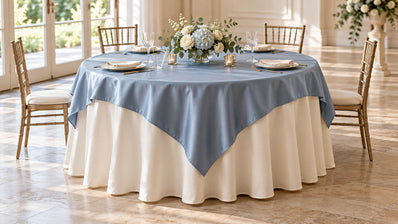
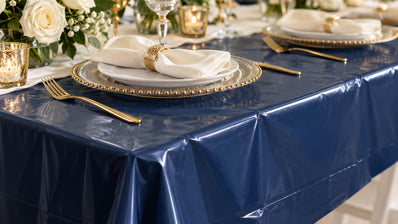
An overlay can make a round table feel layered and finished, but the wrong size can throw off the whole setup. Too small, and it may look like a small accent floating on top. Too large, and it can cover the base tablecloth you meant to show.
Start with the table’s diameter, then decide how much overlay you want to hang over the edge. The chart below shows common sizes for round overlays on round tables. Square overlays drape differently, so their sizing is covered in the next part of the guide.
Round Table Overlay Size Chart
Use the chart to match your table’s diameter with a round overlay size. Each pairing shows the approximate drop on both sides, making it easier to compare a subtle accent with a longer drape.
| Round Table Diameter | Round Overlay Size | Approximate Drop |
|---|---|---|
| 48” | 60” | 6” |
| 72” | 12” | |
| 60” | 72” | 6” |
| 84” | 12” | |
| 90” | 15” | |
| 72” | 90” | 9” |
| 108” | 18” | |
| 120” | 24” | |
| 120” | 132” | 6” |
| 144” | 12” |
Use the chart as a measurement guide, then confirm the size and shape listed for the product you’re considering. Overlay styles can come in different dimensions. You can browse the table overlay collection to compare available options.
Overlay Sizes for Common Round Table Diameters

Use the table diameter as your starting point, then choose an overlay based on the drop you want. These common size pairings show how a few inches of difference can change how much of the base tablecloth remains visible.
48-Inch Round Tables
A 60-inch round overlay gives a 48-inch table about a 6-inch drop. This creates a narrow border of overlay around the table and leaves most of the base cloth visible.
A 72-inch round overlay gives about a 12-inch drop. Choose this size when you want the overlay to show more clearly without covering most of the tabletop’s base layer.
60-Inch Round Tables
For a 60-inch round table, choose the overlay size according to the effect you want:
-
A 72-inch overlay gives about a 6-inch drop for a subtle accent.
-
An 84-inch overlay gives about a 12-inch drop for more coverage.
-
A 90-inch overlay gives about a 15-inch drop for a fuller layer.
These measurements answer the common question, what size overlay for a 60-inch round table? If you’re also choosing the base cloth, use EFM’s round table size guide for tablecloth and seating information.
72-Inch Round Tables
A 90-inch round overlay gives a 72-inch table about a 9-inch drop. For more coverage, a 108-inch overlay gives about 18 inches, while a 120-inch overlay gives about 24 inches.
The 90-inch size keeps the overlay closer to the tabletop. The 120-inch size hangs much lower and makes the overlay a more prominent layer. Check the space around the table before choosing a long drop, especially when guests will be seated around it.
120-Inch Round Tables
A 132-inch round overlay gives a 120-inch table about a 6-inch drop. A 144-inch overlay gives about 12 inches.
Measure the tabletop before selecting a size. Confirm that “120 inches” refers to the table’s diameter, not the measurement of a tablecloth already on it. Product dimensions can vary by style, so check the listed size before ordering.
How to Calculate Overlay Drop
If you know the overlay and table diameters, use this formula:
(Overlay diameter − table diameter) ÷ 2 = drop on each side
For example, a 90-inch round overlay on a 60-inch round table gives a 15-inch drop:
(90 − 60) ÷ 2 = 15 inches
If you know the drop you want and need to find the overlay size, use:
Table diameter + (desired drop × 2) = overlay diameter
For a 60-inch table with a 12-inch drop:
60 + (12 × 2) = 84 inches
So an 84-inch round overlay gives approximately 12 inches of drop on each side. This formula applies to round overlays. A square overlay has corners that extend farther than its sides, so it won’t create an even drop around a round table.
Round Overlays vs. Square Overlays

Both shapes work on a round table, but they create different drapes. A round overlay follows the table’s edge, giving it an even drop all the way around. A square overlay creates four corners that hang lower than the fabric along its sides.
| Overlay Shape | How It Drapes | Best For |
|---|---|---|
| Round | Hangs evenly around the table | A smooth, consistent edge |
| Square | Falls shorter along the sides, with longer points at the corners | A layered, diamond-shaped look |
Center a square overlay carefully so the four corners fall evenly. If the overlay shifts off-center, one point may hang lower than the others.
Choosing the Right Overlay Drop
There’s no single drop that works for every event. Choose one based on how much of the base tablecloth you want to show and whether the table will be used for dining or display.
-
A short drop of about 6 inches adds a border of color or texture while keeping most of the base cloth visible.
-
A medium drop of about 9 to 15 inches creates a more noticeable layer without letting the overlay dominate the table.
-
A longer drop of 18 inches or more makes the overlay more prominent. Check that the fabric won’t interfere with guests’ chairs or legs.
If the table is for a cake, gift, or display, a longer decorative drop may work well. For a dining table, consider how the fabric will hang around seated guests.
Measuring Your Table Before Choosing an Overlay

Before ordering, measure the tabletop itself. A tablecloth already on the table can make it harder to judge the diameter.
-
Measure straight across the center of the tabletop, from one edge to the opposite edge.
-
Decide whether you want a short, medium, or long drop.
-
Use the chart or formula to estimate the overlay size.
-
Check whether the product is round or square.
-
Confirm the product’s listed dimensions before ordering.
If you’re selecting the base linen too, compare options in the round tablecloth collection. For a tablecloth rather than an overlay, the standard tablecloth size guide and tablecloth sizing tool can help you check the fit.
Overlay Fabrics and Size Examples
Fabric affects how the overlay looks against the base cloth. Satin has a smooth finish that catches the light. Polyester is a versatile choice for event tables. Sheer organza lets the base color remain visible.
For a smooth surface, explore satin and taffeta overlays. For a practical fabric with a range of color options, browse polyester overlays.
Overlay Examples by Fabric and Size
These examples show different finishes and dimensions. Use the product measurements to check which option suits your table and preferred drape.


Carousel placement: Place these four products after this section. The fabric and size variations illustrate the choices covered in the article without interrupting the sizing instructions.
Frequently Asked Questions
What size overlay fits a 60-inch round table?
A 72-inch round overlay creates an approximate 6-inch drop. For more coverage, an 84-inch overlay gives about a 12-inch drop, while a 90-inch overlay gives about 15 inches.
What size overlay fits a 72-inch round table?
A 90-inch round overlay gives an approximate 9-inch drop. A 108-inch overlay gives about 18 inches, while a 120-inch overlay gives about 24 inches.
What size overlay fits a 120-inch round table?
A 132-inch round overlay gives an approximate 6-inch drop. A 144-inch overlay gives about 12 inches.
Can you use a square overlay on a round table?
Yes. Center the square overlay so its four corners hang evenly. The corners extend farther down than the sides, creating a pointed, layered look.
How do you calculate the right overlay size?
Add twice the desired drop to the table diameter. For a 60-inch table with a 12-inch drop, calculate 60 + (12 × 2) = 84 inches. An 84-inch round overlay gives an approximate 12-inch drop.
Is a table topper the same as a table overlay?
The terms can vary by retailer. Check the product’s shape, material, dimensions, and intended use. A fabric overlay is typically placed over a base tablecloth as a decorative layer.